


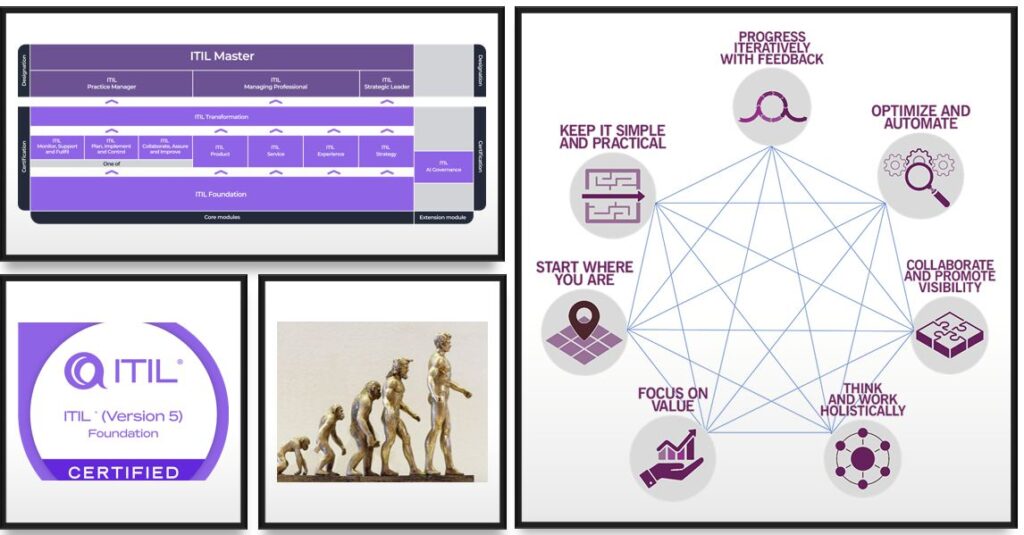
ITIL has long been an established framework for IT Service Management. Through different versions, the framework has evolved in line with changes in technology, organization and business models. ITIL (version 5) is the next step in this evolution, building on previous versions rather than replacing them.
An important indication in connection with ITIL (version 5) is that they want to reduce the focus on version numbers. The idea is not to see each update as a new framework, but as a natural further development. ITIL should be regarded as a living framework that adapts over time.
The new version will be rolled out in the spring of 2025, with a limited range of courses to begin with.
Right now we have two courses to offer:
What’s new?
Clearer focus on value
Already in ITIL 4, there was a shift from a strict process focus to value creation. ITIL (version 5) reinforces this even further. The starting point is not how the work is structured internally, but how services contribute to concrete business benefits.
This means that organisations are encouraged to:
Tie activities more clearly to business goals
Focus on customer experience
Measuring impact rather than just compliance
Further development of the Service Value System
The Service Value System, which was introduced in ITIL 4, remains central. ITIL (version 5) emphasizes the interplay between strategy, governance, delivery and improvement even more clearly.
The holistic perspective is strengthened, especially in environments where several suppliers, cloud services and platforms collaborate. IT is seen as part of a larger ecosystem rather than an isolated function.
Stronger integration with modern ways of working
Agile methodologies, DevOps and Lean are no longer parallel initiatives but integrated into the framework. ITIL (version 5) assumes that organizations work iteratively and in cross-functional teams.
The focus is on:
Continuous flows rather than linear life cycles
Collaboration between development and operations
Faster adaptation to changing needs
More flexible structure
The structure of ITIL (version 5) is somewhat simplified and allows for greater scope for local adaptations. The aim is to reduce the risk of over-implementation and make the framework more practically applicable, even in smaller organizations.
What does this mean for those who are already certified?
Your previous knowledge remains relevant
Certifications from ITIL v3 or ITIL 4 are still valuable. The basic principles of service management, customer focus and continuous improvement remain.
ITIL (version 5) therefore primarily involves an update and deepening, not a departure from previous knowledge.
A shift in perspective
For those who trained in previous versions, the emphasis may have been on processes, roles and documentation. In ITIL (version 5), there is a greater focus on the whole, business value and collaboration.
This means that you need to:
Understand the goals and drivers of the business
Working closely with business managers
See IT as an integral part of the value chain
An opportunity for a more strategic role
ITIL competence combined with an understanding of modern working methods provides good conditions for taking a more advisory or strategic role. The framework supports people who can act as a bridge between technology, operations and management.
How will the organization’s way of working be affected?
Clearer connection to business goals
ITIL (version 5) strengthens the connection between IT and business. Questions about how services contribute to revenue, efficiency and customer experience will be central.
The IT business therefore needs to work more closely with management and business managers.
Changed view of governance
Steering is less about control and more about direction. Organizations are encouraged to set clear goals, follow up on results, and give teams room for manoeuvre within given frameworks.
Cross-functional collaboration
Silos are actively counteracted. Development, operations, safety and operations are expected to collaborate in joint flows. Shared goals and common metrics are becoming more important than separate process optimizations.
Continuous improvement as the norm
Continuous improvement is not a project, but a part of everyday life. Follow-up, learning and adjustment must take place on an ongoing basis. This requires both structure and a culture that encourages transparency and learning.
Ecosystem Management
Modern IT environments consist of several suppliers and cloud services. ITIL (version 5) emphasizes the importance of structured supplier management and coordination across the ecosystem.
Executive summary
ITIL (version 5) is a further development of previous versions and marks a continued move towards value creation, flexibility and a holistic perspective. The version number should not be seen as a breaking point, but as part of continuous development.
For individuals, it mainly means an update of perspectives and terminology. For organizations, this means support for working more closely with the business, more cross-functionally, and more adaptively in a digital and changing environment.
Feel free to contact us at Informator if you want to know more or discuss how you can learn about the new version.